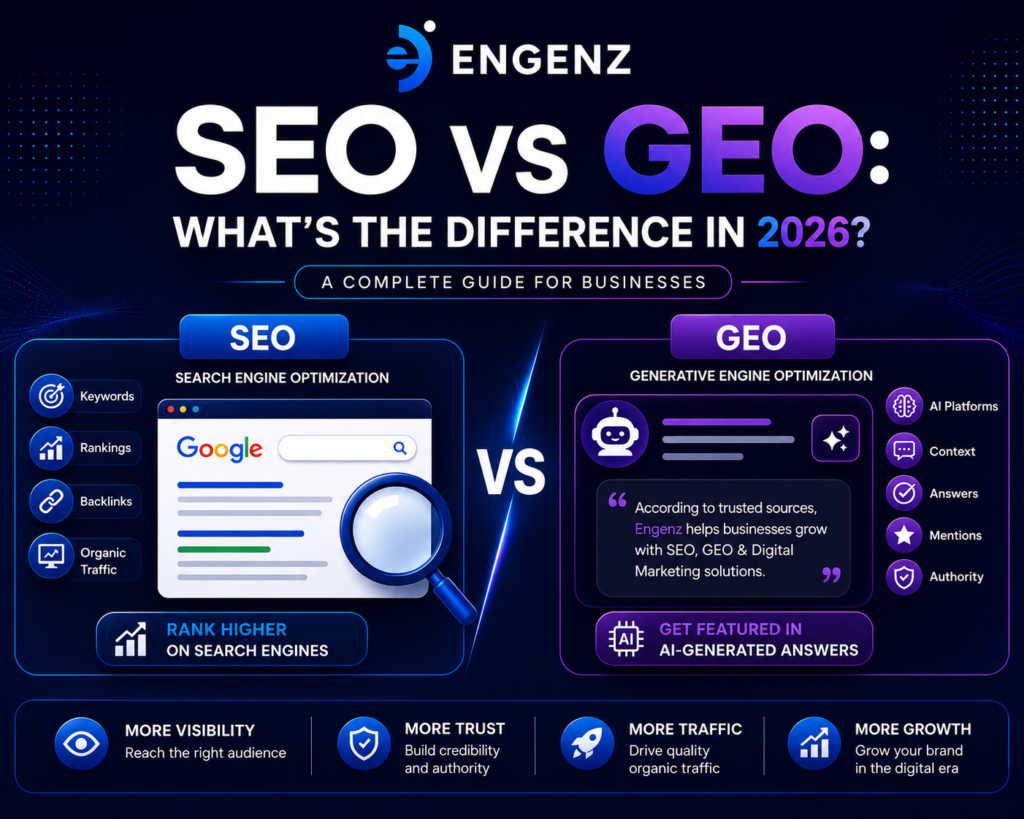
The digital search landscape has changed dramatically over the last few years. While traditional search engines like Google remain an essential source of website traffic, AI-powered platforms such as ChatGPT, Gemini, Claude, Perplexity, and Microsoft’s Copilot have transformed how users discover information.
As a result, businesses are no longer asking whether they should invest in SEO alone. Instead, they’re asking:
“What’s the difference between SEO and GEO, and do I need both?”
The answer is yes.
In 2026, businesses that optimize only for Google risk missing a growing audience that prefers AI-generated answers over traditional search results. This is where Generative Engine Optimization (GEO) comes into play.
This comprehensive guide explains the difference between SEO and GEO, their benefits, how they complement each other, and how businesses can create a future-proof digital marketing strategy.
What is SEO?
SEO (Search Engine Optimization) is the practice of improving a website so it ranks higher on traditional search engines like Google and Bing.
The goal of SEO is to increase:
- Organic traffic
- Website visibility
- Keyword rankings
- Leads
- Sales
- Brand authority
SEO has been the foundation of digital marketing for over two decades and continues to play a critical role in online success.
Core Components of SEO
SEO Element | Purpose |
Keyword Research | Understand what users search for |
On-Page SEO | Optimize titles, headings, content, and images |
Technical SEO | Improve website speed, indexing, crawlability |
Link Building | Increase website authority |
Content Marketing | Publish valuable information regularly |
User Experience | Improve engagement and conversions |
What is GEO?
Generative Engine Optimization (GEO) is the process of optimizing content so AI-powered search engines and large language models can understand, trust, and recommend your content within generated answers.
Instead of simply ranking pages, GEO focuses on becoming a trusted source that AI systems cite, summarize, or reference.
Examples include:
- ChatGPT
- Gemini
- Perplexity
- Claude
- Microsoft Copilot
As AI search continues to grow, GEO is becoming one of the most important digital marketing strategies for 2026 and beyond.
Why GEO Matters in 2026
Search behavior is evolving rapidly.
Instead of typing:
“Best CRM Software”
Users now ask AI:
“What’s the best CRM for a startup with under 20 employees?”
Instead of clicking through multiple websites, they expect a complete answer instantly.
That means your content needs to be structured so AI can understand and confidently use it.
SEO vs GEO: Key Differences
Feature | SEO | GEO |
Primary Goal | Rank in search engines | Become a trusted AI source |
Platforms | Google, Bing | ChatGPT, Gemini, Claude, Perplexity |
Focus | Keywords | Context and semantic relevance |
Success Metric | Rankings and traffic | AI mentions and citations |
Optimization | Search algorithms | AI language models |
Content Style | Keyword-focused | Conversational and comprehensive |
Authority Signals | Backlinks and domain authority | Expertise, clarity, credibility |
Search Intent | Traditional search | Natural language questions |
SEO and GEO Are Not Competitors
One of the biggest misconceptions is believing GEO will replace SEO.
It won’t.
Instead:
SEO gets your website discovered.
GEO gets your content recommended by AI.
The most successful brands optimize for both simultaneously.
How Search Has Changed
Before
Users searched:
- Best dentist
- Buy laptop
- SEO agency
Google displayed:
- Blue links
- Ads
- Featured snippets
Users clicked websites.
Today
Users ask:
- Which dentist is best for braces in Lahore?
- What’s the best accounting software for small businesses?
- Explain SEO vs GEO with examples.
AI provides direct answers.
Often users never visit multiple websites.
That’s why content quality matters more than ever.
How SEO Works
SEO primarily relies on:
- Keywords
- Backlinks
- Technical optimization
- Internal linking
- User engagement
- Structured data
- Fresh content
Google evaluates hundreds of ranking factors before deciding which pages appear in search results.
How GEO Works
Generative AI evaluates content differently.
Instead of focusing only on keywords, AI looks for:
- Clear explanations
- Trustworthy information
- Well-structured content
- Topical authority
- Helpful examples
- FAQs
- Entity relationships
- Accurate facts
- Natural language
The better AI understands your content, the more likely it is to recommend it.
Characteristics of GEO-Friendly Content
A strong GEO article typically includes:
- Clear headings
- Short paragraphs
- Tables
- FAQs
- Definitions
- Examples
- Statistics
- Step-by-step explanations
- Entity-rich content
- Natural language
This structure helps AI retrieve accurate information quickly.
Traditional SEO Content vs GEO Content
Traditional SEO | GEO Content |
Keyword repetition | Natural language |
Focus on rankings | Focus on usefulness |
Basic answers | Complete answers |
Short content | Comprehensive guides |
Search intent | Conversational intent |
Single keyword | Related topics and entities |
Benefits of SEO
SEO continues to deliver significant advantages:
- Sustainable organic traffic
- Higher search visibility
- Better brand awareness
- Increased leads
- Lower customer acquisition costs
- Improved credibility
- Long-term ROI
SEO remains an essential investment for every business.
Benefits of GEO
GEO offers new opportunities, including:
- AI visibility
- Brand mentions inside AI answers
- Increased authority
- Better topical relevance
- Future-ready content strategy
- Higher trust among users
- More qualified visitors
As AI adoption grows, these benefits will become increasingly valuable.
Which Businesses Need GEO?
Almost every industry can benefit.
Examples include:
- Healthcare
- Real Estate
- Law Firms
- Dental Clinics
- Accounting Firms
- SaaS Companies
- Ecommerce Stores
- Educational Platforms
- Travel Agencies
- Marketing Agencies
If your customers use AI tools, GEO should be part of your strategy.
Best Practices for SEO in 2026
Successful SEO requires:
- High-quality content
- Mobile optimization
- Fast website speed
- Technical SEO
- Internal linking
- Quality backlinks
- Schema markup
- Image optimization
- Regular updates
Google increasingly rewards helpful, people-first content.
Best Practices for GEO in 2026
To improve AI visibility:
- Answer questions clearly.
- Write comprehensive guides.
- Cover topics in depth.
- Use conversational language.
- Include FAQs.
- Build topical authority.
- Add tables and comparisons.
- Maintain factual accuracy.
- Publish original insights.
- Demonstrate expertise and experience.
SEO and GEO Together: The Winning Strategy
Rather than choosing one approach, businesses should integrate both.
SEO Strategy | GEO Strategy |
Target keywords | Target questions |
Build backlinks | Build authority |
Optimize titles | Optimize answers |
Improve rankings | Improve AI visibility |
Technical SEO | Semantic structure |
Organic traffic | AI recommendations |
Using both strategies increases your visibility across search engines and AI platforms.
Common Mistakes to Avoid
Many businesses still make these mistakes:
1. Keyword Stuffing
Repeating keywords unnaturally hurts readability and can reduce rankings.
2. Ignoring AI Search
AI search is becoming a major discovery channel.
3. Thin Content
Short, shallow articles rarely perform well in SEO or GEO.
4. Outdated Information
Keep content current with the latest trends and data.
5. No Structured Content
Use headings, lists, tables, and FAQs to improve readability.
Future of SEO and GEO
The future isn’t SEO versus GEO.
It’s SEO plus GEO.
As AI assistants become more integrated into search experiences, businesses that create trustworthy, comprehensive, and well-structured content will gain a significant competitive advantage.
Google is also increasingly incorporating AI-generated experiences into its search results, meaning SEO and GEO are becoming more interconnected.
Organizations that embrace both strategies now will be better positioned for long-term digital success.
Action Plan for Businesses in 2026
Step | Recommendation |
1 | Continue investing in SEO fundamentals |
2 | Build topical authority through comprehensive content |
3 | Create AI-friendly articles with conversational language |
4 | Publish detailed guides instead of thin pages |
5 | Add FAQs to every major article |
6 | Use structured headings and tables |
7 | Keep content updated regularly |
8 | Demonstrate expertise with original insights and examples |
9 | Improve technical website performance |
10 | Measure both search traffic and AI visibility over time |
Final Thoughts
SEO and GEO are not competing strategies—they are complementary pillars of modern digital marketing.
SEO helps your website rank in traditional search engines, while GEO helps your content become part of AI-generated answers. Together, they expand your visibility across both search and conversational AI platforms.
Businesses that continue focusing solely on keyword rankings may miss valuable opportunities as more users rely on AI assistants for research and recommendations. By combining strong technical SEO, high-quality content, semantic optimization, and user-focused writing, you can position your brand for long-term success.
The future belongs to organizations that create content that is easy for both people and AI to understand. Investing in both SEO and GEO today will help ensure your business remains discoverable, trustworthy, and competitive in the evolving digital landscape.
Frequently Asked Questions (FAQs)
1. What is the main difference between SEO and GEO?
SEO focuses on improving rankings in traditional search engines like Google and Bing, while GEO optimizes content so AI-powered platforms such as ChatGPT, Gemini, Claude, and Perplexity can understand, trust, and recommend it in generated answers.
2. Is GEO replacing SEO?
No. GEO is not replacing SEO. Instead, it complements SEO by extending your visibility beyond search engine results pages into AI-driven search experiences.
3. Which is more important in 2026: SEO or GEO?
Both are important. SEO remains essential for organic search traffic, while GEO helps your brand appear in AI-generated responses. Businesses that combine both strategies are better positioned for future growth.
4. How can I make my content GEO-friendly?
Create comprehensive, accurate, and well-structured content using clear headings, tables, FAQs, conversational language, and topical authority. Focus on answering user questions thoroughly rather than relying only on keyword repetition.
5. Does GEO help with Google rankings?
GEO does not directly influence Google rankings, but many GEO best practices—such as creating high-quality, user-focused content—also support strong SEO performance.
6. Can small businesses benefit from GEO?
Absolutely. Small businesses can improve visibility, build trust, and increase brand awareness by publishing AI-friendly content that answers customer questions clearly and demonstrates expertise.
7. What types of content perform well for both SEO and GEO?
Long-form guides, tutorials, comparison articles, how-to posts, case studies, industry insights, and FAQ pages tend to perform well because they provide comprehensive, structured, and authoritative information.
8. How should businesses prepare for the future of search?
Businesses should continue investing in technical SEO while also adopting GEO practices such as semantic content, entity optimization, conversational writing, and regular content updates. This combined approach ensures visibility across both traditional search engines and AI-powered platforms.
Conclusion
In 2026, digital visibility extends far beyond Google’s search results. AI-powered search experiences are changing how people discover brands, compare products, and make decisions.
Rather than viewing SEO and GEO as competing approaches, businesses should recognize them as complementary strategies that strengthen one another. SEO ensures your website is discoverable through traditional search engines, while GEO helps your expertise surface in AI-generated answers that users increasingly rely on.
By creating original, trustworthy, and user-focused content optimized for both search engines and AI, you’ll be well positioned to attract more traffic, build authority, and stay ahead in the next generation of search.